
Five Essential Tips for a Reverse Missionary
by Lierte Soares
Introduction
The twenty-first century has witnessed one of the most remarkable shifts in the history of Christianity. For centuries, missionaries traveled primarily from Europe and North America to the rest of the world. Today, however, a new reality has emerged. Churches from Latin America, Africa, and Asia are sending missionaries to Europe and North America. This movement has become known as Reverse Mission.
Reverse Mission is not a reversal of the Great Commission itself. Rather, it is a reversal of missionary direction. Nations that once received missionaries are now sending missionaries. The Gospel is completing a historical circle.
Yet many missionaries entering Western societies quickly discover that passion alone is not enough. The post-Christian West presents unique challenges. Secularism, individualism, skepticism toward religion, and rapidly changing cultural norms require missionaries to develop new skills and attitudes.
Throughout my years serving in New England, one of the most secular regions of the United States, I have observed that successful reverse missionaries share several common characteristics. While there are many lessons to learn, five principles consistently emerge as essential for effective ministry.
1. Learn the Culture
One of the greatest mistakes a missionary can make is assuming that the Gospel and culture are the same thing.
The Gospel is eternal. Culture is not.
Many missionaries arrive in a new country believing they understand the people because they speak the language or have visited before. However, genuine cultural understanding requires intentional learning.
Missionaries must become students before they become teachers.
This means learning:
The history of the nation
The values that shape society
Social customs and expectations
Communication styles
Religious and philosophical assumptions
Current cultural challenges
The Apostle Paul demonstrated this principle in Athens. Before preaching on Mars Hill, he carefully observed the culture around him. He studied their beliefs, examined their altars, and understood their worldview (Acts 17:22-23).
Effective missionaries listen before speaking.
Learning culture also includes language acquisition. Even when people speak English, there are cultural nuances, expressions, humor, and communication patterns that require time to understand.
Cultural intelligence is not optional. It is essential.
When missionaries fail to understand culture, they often create unnecessary barriers to the Gospel. When they understand culture, they can communicate biblical truth in ways people can understand and receive.
2. Depend on the Holy Spirit
While cultural understanding is crucial, reverse mission cannot be reduced to sociology, strategy, or methodology.
The Church was born through the power of the Holy Spirit.
Jesus commanded His disciples not to begin ministry until they had received power from on high (Acts 1:8). The same principle remains true today.
Many missionaries spend years preparing academically and professionally. Such preparation is valuable, but no amount of education can replace dependence on God.
The Holy Spirit provides:
Wisdom for ministry decisions
Courage during opposition
Discernment in difficult situations
Power for evangelism
Guidance in relationships
Strength during discouragement
Reverse missionaries often serve in environments where visible results may be slow. In highly secular societies, people may take years before showing interest in spiritual matters.
Without dependence on the Holy Spirit, discouragement can easily take root.
Prayer must remain the foundation of reverse mission.
Every church plant, evangelistic conversation, discipleship relationship, and ministry initiative must be saturated with prayer.
The future of Reverse Mission will not ultimately be determined by budgets, buildings, or programs. It will be determined by men and women who walk daily in the power of the Holy Spirit.
3. Build Relationships
Mission is fundamentally relational.
Western societies often struggle with loneliness despite being highly connected through technology. Many people have hundreds of online connections but very few genuine friendships.
This creates both a challenge and an opportunity.
The challenge is that trust must often be earned slowly. The opportunity is that authentic relationships become powerful bridges for the Gospel.
People are more likely to listen to those who genuinely care about them.
Jesus consistently demonstrated relational ministry. He ate with people. He walked with people. He listened to people. He entered their lives before calling them to follow Him.
Reverse missionaries must do the same.
Relationship-building may involve:
Sharing meals
Participating in community events
Volunteering locally
Helping neighbors
Listening to people's stories
Investing in long-term friendships
In New England, I have often seen that ministry begins not in the sanctuary but at a coffee shop, school event, sports field, or community gathering.
Relationships open doors that programs cannot.
The missionary who views people merely as evangelistic projects will struggle. The missionary who genuinely loves people will find opportunities to share Christ naturally and effectively.
The Gospel travels best through trusted relationships.
4. Serve with Patience
One of the greatest challenges facing reverse missionaries is managing expectations.
Many come from regions where churches grow rapidly and public expressions of faith are common. They arrive in Western societies expecting similar results and become discouraged when growth appears slow.
Patience is a missionary virtue.
The farmer does not plant a seed today and expect a harvest tomorrow. The same principle applies to ministry.
In post-Christian societies:
Trust often develops slowly
Conversion may be gradual
Discipleship requires significant investment
Church planting takes time
Community transformation happens over years
Missionaries must learn to celebrate small victories.
A meaningful conversation. A new friendship. A first visit to church. A person beginning to read Scripture. A family opening their home for prayer.
These moments matter.
God often works beneath the surface long before visible fruit appears.
Many missionaries abandon promising ministries because they expect immediate results.
Faithfulness is more important than speed.
The reverse missionary must develop a long-term perspective, trusting that God is working even when progress cannot yet be seen.
5. Honor the Nation
Perhaps one of the most overlooked principles of reverse mission is learning to honor the nation where God has called you.
Some missionaries arrive with criticism rather than compassion. They focus on the spiritual decline of a nation while forgetting its history, sacrifices, and contributions.
Biblical missionaries honored the people they served.
Honoring a nation does not mean agreeing with everything in its culture. It means respecting its people, laws, institutions, and history.
Jeremiah instructed God's people to seek the welfare of the city where they lived (Jeremiah 29:7).
This principle remains relevant today.
Missionaries should:
Pray for government leaders
Respect local laws
Participate in community life
Appreciate national traditions
Learn the nation's story
Serve as responsible citizens and residents
When missionaries demonstrate genuine love for their adopted nation, they gain credibility and trust.
People quickly recognize whether a missionary truly loves them or simply sees them as a ministry assignment.
Reverse mission is most effective when it flows from a heart of gratitude and service.
We do not come to conquer cultures.
We come to serve people.
Conclusion
Reverse Mission represents one of the most exciting developments in global Christianity. God is using believers from every continent to advance His Kingdom in every nation.
Yet effective reverse missionaries understand that success requires more than enthusiasm.
They learn culture. They depend on the Holy Spirit. They build relationships. They serve with patience. They honor the nation where God has called them.
When these principles are embraced, missionaries become bridges between cultures rather than barriers. They demonstrate the beauty of the Gospel while remaining faithful to its truth.
The future of Christianity will increasingly be multicultural, multilingual, and globally interconnected. Reverse missionaries stand at the forefront of this movement.
The Gospel is not traveling in a new direction. It is completing a circle.
And God is inviting a new generation of missionaries to participate in His global mission.
The Gospel has come full circle.
About the author
Lierte Soares Junior is a Brazilian-American pastor, missiologist, educator, and denominational leader serving in New England, United States. He is recognized as a practitioner of reverse mission, having been commissioned from Brazil to minister within one of the most historically significant yet increasingly secularized regions of North America. His ministry focuses on church revitalization, evangelism, leadership development, and cross-cultural engagement. He currently serves as President of the Baptist Churches of New England (BCNE), where he provides strategic leadership for churches across the six New England states.
Soares possesses a multidisciplinary academic background that integrates theology, law, education, business, and missiology. He earned a Bachelor of Arts in Theology from Faculdade de Teologia Integrada (Brazil), a law degree from Faculdade de Direito Vale do Rio Doce, as well as undergraduate degrees in Business Administration and Education. He further pursued theological studies in the United States, earning a Master of Divinity (M.Div.) from Midwestern Baptist Theological Seminary and a Master of Theological Studies (M.T.S.) with a concentration in Cross-Cultural Missions from Southwestern Baptist Theological Seminary. He is currently pursuing a Doctor of Ministry (D.Min.) in Missions and Evangelism at Southwestern Baptist Theological Seminary.
His academic formation has significantly shaped his understanding of global Christianity, intercultural ministry, and missionary leadership. Drawing upon theological scholarship and practical ministry experience in both Latin America and North America, Soares has developed a ministry model that emphasizes church revitalization through the lens of reverse mission. His work explores the growing role of the Global South in the re-evangelization of historically Christian societies and contributes to contemporary discussions concerning migration, diaspora missiology, intercultural leadership, and the shifting center of gravity within global Christianity.
As both a scholar-practitioner and denominational leader, Soares has become an emerging voice in the field of reverse mission, particularly within Baptist contexts. His ministry and writing seek to foster collaborative partnerships between churches in the Global South and North America, advancing a vision of mission that reflects the increasingly polycentric and interconnected nature of the contemporary Christian movement.
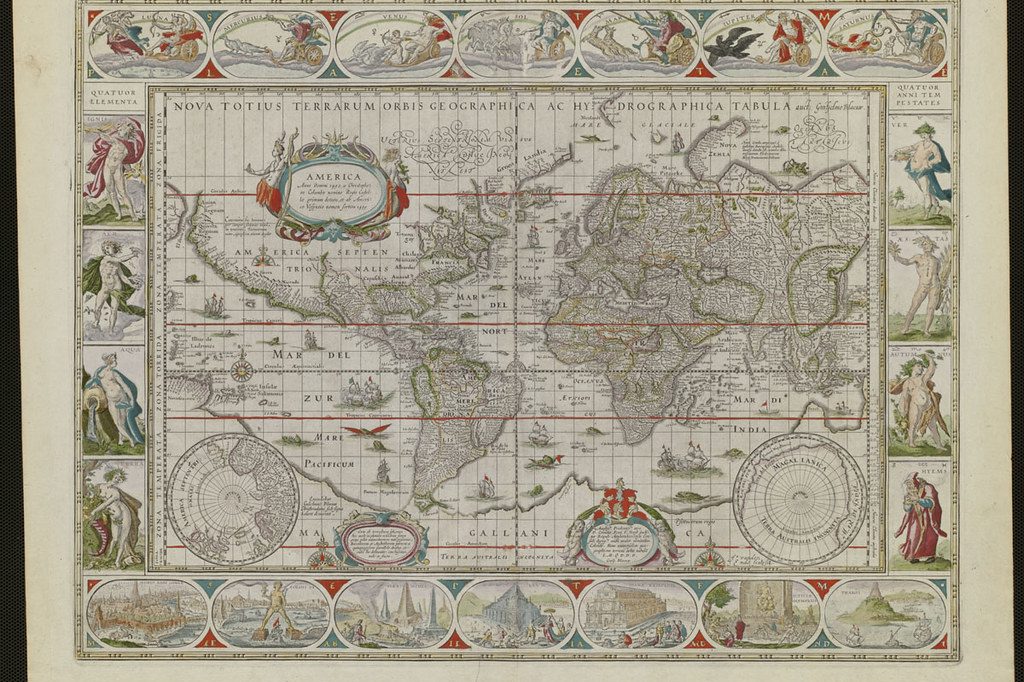
Cover image: antique world map (“Noua totius terrarum orbis geographica ac hydrographica”) via Flickr (CC BY 2.0).